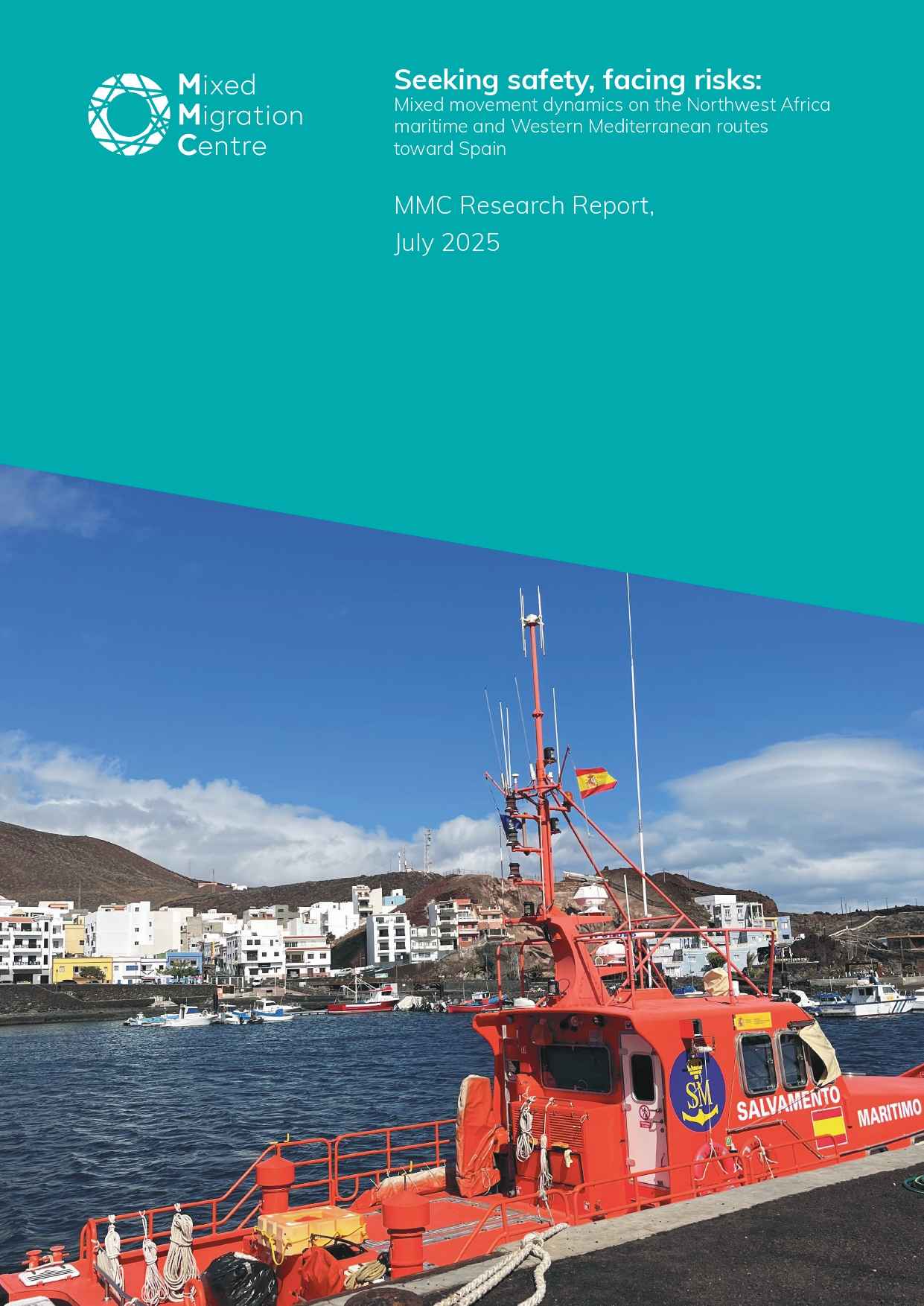
Mixed movement dynamics on the Northwest Africa maritime and Western Mediterranean routes toward Spain
Throughout 2024, MMC, in partnership with UNHCR, interviewed 497 migrants and refugees recently arrived in Spain via the Canary Islands, the Mediterranean, or via the land crossing in Ceuta and Melilla.The interviews aimed to explore their movement drivers, journeys, as protection risks in transit, asylum and onward movement intentions from Spain.
While most of the mixed movements towards Spain come from South American countries, the Western Mediterranean and the Atlantic remain the most important mixed movement routes from Africa toward Spain, and Europe more in general. The steady increase in irregular arrivals via the Canary Islands since 2020 has catalysed the attention of EU policymaking and has continued to strain the reception system in the Canary Islands. In 2025, crackdowns on departures from Mauritania led to a reduction in irregular crossings.
However, the Atlantic remains one of the deadliest sea crossings worldwide, and the land journeys to embarkation points also remain fraught with risks. Meanwhile, the Western Mediterranean route continues to be used by migrants and refugees from West and East African countries, who must cross North Africa to reach the Mediterranean shores, and also poses several risks.
This report draws on 497 interviews with refugees and migrants who arrived in Spain between February and December 2024. The research examines the drivers of their movement, their experiences, including perceived dangerous locations, and information sources. The analysis concludes with a section on the implications of the data for interventions and responses aimed at enhancing protection and assistance to refugees and migrants along Western Mediterranean Route (WMR) and Northwest African Maritime Route (NWAMR).
Key findings
Violence, insecurity, and conflict are a main driver of primary movement as indicated by 69% of all respondents. Violence-related drivers were the predominant choice among the various multi-select options for all but Moroccan nationals, and the sole driver for 63% of all respondents.
Women of all surveyed nationalities reporting violence, insecurity, and conflict as a primary driver of movement (n=83), commonly specified gender-based violence (GBV). This included forced marriage (reported by 51 respondents) and domestic violence (reported by 49 respondents) alongside other forms GBV (reported by 53 respondents).
43% of respondents reported that embarking on irregular journeys was the only available option, with a third of respondents (32%) feeling that the route used was their only option.
Respondents consistently identified the Atlantic Ocean as the most dangerous part of the NWAMR while dangerous locations along the WMR included land routes in North African countries, where risks such as death, physical violence, robbery, and detention were reported.
Respondents reported information gaps on crucial aspects of the journey including conditions, duration, safety, and route options. Information gaps were most commonly reported by respondents who arrived in Spain via the WMR (n=174), of which 57% did not obtain information about route, costs, journey, prior to departure, compared to 49% of those who arrived in Spain via the NWAMR (n=323).
Respondents identified informal networks (such as family and friends in their country of origin, in diaspora communities, and in their country of intended destination) as the most reliable source of information.
Most respondents (71%) reported having reached their destination; of these (n=352) the majority had either applied or were intending to apply for asylum (91%).
Only 10% of respondents applied for asylum before reaching Spain. The reasons for not seeking asylum before reaching Spain varied between the NWAMR and the WMR. Along the NWAMR (n=204), primary barriers were a lack of awareness and information about asylum procedures (40%), while for those on the WMR (n=112), insecurity (34%) and restricted access to asylum systems (30%) were the main obstacle
See also
Beyond restrictions: migration & smuggling across the Mediterranean, the Atlantic & the English Channel
Related Resources
Research Reports and Papers
Migration from Burkina Faso to northern Côte d’Ivoire in the context of climate change
Snapshots and Infographics
Sudanese journeys reaching the Western Mediterranean Route
Snapshots and Infographics
How access to information impacts refugees’ and migrants’ experiences on their journey to Senegal
Quarterly Mixed Migration Update
West Africa, Quarter 2, 2026
Stay in the loop
Get mixed migration data, analysis and research from each region - straight to your inbox. Stay up to date with our newsletter.
Institutional Insight
Stay informed with the latest evidence-based data and research on global mixed migration.